
The Urjit Patel committee on monetary policy framework has proposed setting up of a monetary policy committee (MPC) that will be headed by the Reserve Bank of India (RBI) governor and accountable for achieving inflation target set by it.

Although this may not be music to Raghuram Rajan and Viral Acharya's ears, the real reason in my estimation for their quitting is expatriate over-sensitivity, intolerance or arrogance, argues B S Raghavan, the distinguished civil servant.

The friction with the political class is not only about interest rates and monetary policy. While the government often spoke freely about its discomfiture, the RBI had to be careful even in its response to the government as any loose statement would affect the markets.
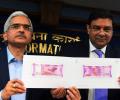
Three key babus will make room for a new set of officers to carry the baton of Budget programmes.
RBI conducts interviews for first lateral hire for CGM post; deputy governors to head four distinct verticals.
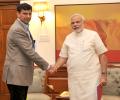
The government's critics say that the Prime Minister failed to rein in vicious and unprecedented personal attacks on the central bank chief by the likes of Rajya Sabha MP Subramanian Swamy.
Owing to Finance Minister Nirmala Sitharaman being new to her role, a number of crucial announcements in the Budget bore Garg's imprint, especially the decision to borrow in overseas markets, reduce the fiscal deficit as a percentage of gross domestic product, and resort to off-Budget borrowing to meet that target, says Arup Roychoudury.

Hopefully, the grey world of central banking in a nation hit by demonetisation, will lighten up with some of his notes soon.
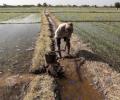
Among the states due for election next year are AP, Haryana and Odisha, which have a fair share of agri credit. If these states individually announced debt relief, the combined waiver would be at least around Rs 600 bn to Rs 700 bn. Clearly, this will be a frightening challenge for Indian banks.
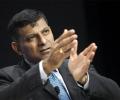
Rajan, as expected, furthered his predecessors' agenda and continued with the same resolution to make India's financial system safer, and direct the economy towards further liberalisation

'...Unless we muck up our policies.' 'We have to become a modernised economy.' 'Our institutions should be stronger. And that is most important.' 'The rule of law should prevail and contracts should be enforced.' 'Above all, we have to recognise the importance of globalisation.' 'It is in our favour at this stage. We should grow and become globally competitive.'

This is the first time in the RBI's history that a governor is leaving without willing to renew his contract

'Tilting at the Government in English in front of India may make him feel like Joan of Arc, but without a feel for Bharat he will merely be Don Quixote,' says S Muraleedharan, former managing director, BNP Paribas.
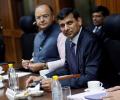
Balance is needed in selecting members for the proposed monetary policy committee, says Abheek Barua.

Inflation targeting framework is now enshrined as a formal agreement by the government and the RBI; thus, it may seem that we are flogging a dead horse, says Soumya Kanti Ghosh.
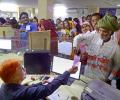
James Wilson tracks down discrepancies in the much-hailed demonetisation policy and the subsequent statements of the government and the Reserve Bank of India.
'The RBI risks becoming dangerously weakened, as successive governments and finance ministers have misunderstood its role'.

'The RBI is something like a seat belt. As a driver, the driver being the government, it has the possibility of not putting on a seat belt but of course if you do not put on your seat belt you get into an accident and the accident can be quite severe,' Raghuram Rajan told CNBC TV18. 'The aim of the board is to be Rahul Dravid -- sensible, thoughtful and not, with due respect, Navjot Sidhu,' he added.

'The autonomy of essential institutions is clearly under question as the Modi government seeks to influence them politically.' 'The credibility of institutions such as the EC, the CBI, the CVC, the UPSC, the RBI, media, and universities, has been compromised,' notes Zoya Hasan, the distinguished political thinker.

Sahil Kapoor of Edelweiss Retail Capital Market Research says that setting up a monetary policy committee should have been the first step. And the central bank could have moved towards a formal inflation targeting mechanism after the processes and data sets are in place.

While the PM sees zero tax on long-term capital gains and dividend income as unfair since the beneficiaries are not poor, he is silent on the fact that rich farmers too don't pay taxes, since farm income is tax-free, a loophole exploited by many netas and babus, says Debashis Basu.

That's all it takes to protect an institution -- just one person with no past and no greed for the future, says Shekhar Gupta.

Government looking at cushioning slowdown due to demonetisation with sops and higher outlay for micro, small and medium enterprises, agriculture, and affordable housing.
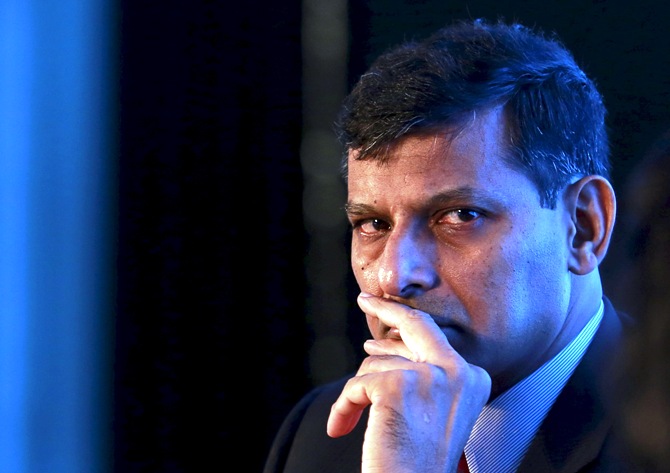
We need a change in mindset, says the RBI Governor.

A glance back at some important events that occurred in 2018.

The Indian economy was on an impressive growth path through the first decade of this century till it was brought to an abrupt halt by the policy inertia during UPA2 and the Modi government's inability to restore economic and financial momentum. Fascinating glimpses of what went wrong from Puja Mehra's must-read book The Lost Decade: How India's Growth Story Devolved Into Growth Without A Story.

Several Congress leaders interpreted it as a dig at Prime Minister Modi who is yet to address a single press conference in his 54-month tenure.
RBI in wait and watch mode as several risks to inflation continue to exist including a sudden reversal of food prices and oil price volatility.
Congress demanded a judicial inquiry by a sitting high court judge.

'There is no difference between the earlier government and the present government.' 'They are all following the economic policy based on the Chicago School of thought.' 'This school of thought says the government should have very little role in governing the country and the majority of the work should be handed over to the private sector.' 'This has not succeeded in the US.' 'Yet, it is being tried here by people like Arvind Subramaniam, Arvind Panagariya, Urjit Patel and Raghuram Rajan.'

The RBI governor has to convert the zero-sum game with the government from a non-cooperative one -- which his two predecessors had made it -- to a cooperative one, explains T C A Srinivasa Raghavan.

If receipts from disinvestment, tax buoyancy and black money scheme offset shortfall in spectrum sale, higher expenditure due to pay commission's recommendations and capital expenditure, then the government would be able to meet the target of controlling fiscal deficit at 3.5 per cent of GDP this financial year.

Angry Congress members staged a walkout during Modi's address.
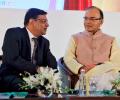
'Who would want to be the man nominally in charge of driving the economy when your boss orders you to swerve it into a ditch of unknown depth?'
'Demonetisation demonstrates that this government is simply too amateurish in terms of economic policy-making to properly address India's deep, deep problems,' argues Mihir S Sharma.

'Poor home work, and a subsequent loss of nerve.' 'This sums up the Modi government's current travails, the stall in key sectors, fading momentum, irritability,' points out Shekhar Gupta.
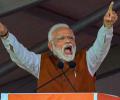
'Modi remains the most popular politician in India; the BJP's organisational and fundraising prowess is considerable; and the Opposition, while newly collaborative, has no leader or clear economic messaging as of yet.'
'When I met the prime minister on November 15 there was no RBI report with the prime minister as to why this was done.' 'When I asked the PMO officer about this, he said the RBI did not bring this to the PM and did it independently.' 'When I asked how could the RBI ban DCCBs from accepting deposits from farmers in old notes when the government gazette released on November 9 allowed them to do so, this officer told me that not even senior PMO officials had any idea about this RBI ban.'
 © 2026 Rediff.com - Advertise with us - Disclaimer - Privacy Policy - Sitemap - Feedback - About us - Terms of use - Grievances